


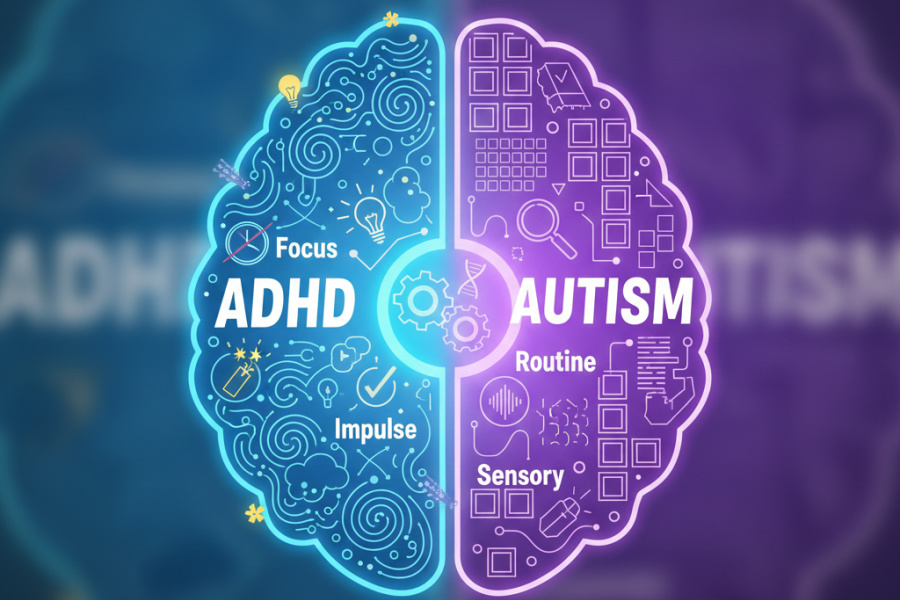
Two Conditions That Are Often Confused
One of the most common questions clinicians and families encounter is whether ADHD and autism are the same condition, or whether one is a type of the other. The short answer is no. ADHD and autism are two distinct neurodevelopmental conditions, each with its own diagnostic criteria, neurological profile, and pattern of challenges.
That said, the confusion is understandable. Both conditions can affect attention, communication, emotional regulation, and social interaction. Both are present from childhood, often go unrecognised for years, and can look remarkably similar in certain contexts. They also co-occur at a significantly high rate, which adds another layer of complexity to diagnosis and support.
This guide is intended for adults who are questioning their own neurology, and for parents trying to understand what their child is experiencing. It explains how ADHD and autism differ, what they share, what it means when both are present, and how an accurate diagnosis in the UK can make a meaningful difference to the support a person receives.
Table of Contents
- Introduction: Two Conditions That Are Often Confused
- What Is ADHD?
- What Is Autism?
- Are ADHD and Autism the Same Thing?
- Key Differences Between ADHD and Autism
- What ADHD and Autism Have in Common
- Can Someone Have Both ADHD and Autism? Understanding AuDHD
- How Are ADHD and Autism Diagnosed in the UK?
- Treatment and Support Options
- When to Seek an Assessment in the UK
- Frequently Asked Questions
- Conclusion
- A Note on Professional Guidance
What Is ADHD?
ADHD, or Attention Deficit Hyperactivity Disorder, is a neurodevelopmental condition characterised by persistent and clinically significant difficulties with attention regulation, impulse control, and in some cases, activity levels. It affects the way the brain manages executive functioning, which includes planning, organising, prioritising, and regulating behaviour.
ADHD is not a reflection of intelligence or effort. It reflects a genuine difference in how the brain processes stimulation and regulates its own activity, particularly in areas governed by the neurotransmitters dopamine and noradrenaline.
ADHD is classified into three presentations:
- Predominantly inattentive, where difficulties with focus, forgetfulness, and organisation are the main features
- Predominantly hyperactive-impulsive, where restlessness, impulsivity, and difficulty waiting are most prominent
- Combined presentation, where both sets of features are present to a clinically significant degree
In adults, hyperactivity often becomes internal rather than visible. It may present as racing thoughts, an inability to relax, or a persistent sense of mental restlessness rather than physical overactivity.
What Is Autism?
Autism, formally referred to as Autism Spectrum Disorder or ASD, is a neurodevelopmental condition characterised by differences in social communication and interaction, alongside restricted, repetitive patterns of behaviour, interests, or activities. Like ADHD, it originates in early development and is a lifelong condition.
Autism affects the way a person perceives and interacts with the world. Autistic people often process sensory information differently, may have strong preferences for routine and predictability, and may find the unwritten social rules that neurotypical people navigate intuitively to be genuinely confusing or inaccessible.
Autism is described as a spectrum, not because it ranges from mild to severe in a linear way, but because it presents very differently from person to person. Some autistic people require significant support with daily living. Others function independently in many areas of life but still experience meaningful challenges in specific domains such as social situations, sensory environments, or adapting to unexpected change.
Are ADHD and Autism the Same Thing?
No. ADHD and autism are separate and distinct conditions. They appear under different diagnostic categories in both the DSM-5, which is the Diagnostic and Statistical Manual of Mental Disorders, and the ICD-11, which is the International Classification of Diseases used widely in the UK.
Historically, prior to the DSM-5 being published in 2013, clinicians were not permitted to diagnose both conditions simultaneously. If someone received an autism diagnosis, ADHD could not be formally co-diagnosed. This restriction has since been lifted, and it is now recognised that the two conditions can and frequently do occur together.
The distinction between the two matters clinically. While their surface presentations can overlap, the underlying mechanisms are different, and the support strategies that work well for one condition do not always translate directly to the other. An accurate diagnosis ensures that a person receives the right interventions, rather than a generic approach that may miss key areas of need.
Key Differences Between ADHD and Autism
Understanding where these two conditions diverge is important for both recognition and clinical assessment. The following areas represent the most clinically significant differences.
Social Interaction and Communication
People with ADHD are often naturally socially motivated. They may be talkative, eager to engage, and socially enthusiastic, though impulsivity can lead to interrupting, talking over others, or shifting topics unexpectedly. The social difficulties in ADHD tend to stem from poor impulse control and difficulty regulating conversations rather than a fundamental difference in how social communication is processed.
Autistic people may experience more fundamental differences in how they interpret and engage with social interaction. Difficulty reading nonverbal cues, challenges with reciprocal conversation, and differences in understanding unstated social expectations are common features. Some autistic people find social interaction genuinely exhausting or confusing in ways that go beyond simple distraction or impulsivity.
Routine and Predictability
A strong preference for routine, order, and predictability is a well-established feature of autism. Autistic people may become significantly distressed when routines are disrupted, and may develop specific rituals or systems that provide a sense of structure and safety.
People with ADHD tend to have the opposite relationship with routine. The ADHD brain often finds repetition demotivating and is drawn toward novelty and new stimulation. Sitting with the same routine day after day can feel genuinely difficult for someone with ADHD, whereas for many autistic people it provides comfort.
Movement and Stimming
Children and adults with ADHD often move because they cannot comfortably sit still. The movement is linked to restlessness and excess energy that is difficult to contain.
Autistic people may engage in repetitive movements, known as stimming, which serve a self-regulatory function. Stimming such as hand-flapping, rocking, or finger-tapping is not random restlessness. It is typically purposeful behaviour that helps manage sensory input, express emotion, or self-soothe. The distinction between ADHD-related movement and autistic stimming is clinically meaningful.
Attention and Focus
In ADHD, attention is primarily regulated by interest and stimulation. Tasks that are novel, urgent, or highly engaging may hold attention well, while routine or low-stimulation tasks see attention drop rapidly.
In autism, attentional differences often centre on depth of focus. Many autistic people concentrate deeply on areas of intense interest, sometimes to the exclusion of other things. Where ADHD produces broad, shifting attention that can feel difficult to control, autistic attention may be more fixed and persistent, particularly around specific subjects or routines.
Sensory Processing
While sensory sensitivities can occur in both conditions, they are a core diagnostic feature of autism. Autistic people may be significantly over- or under-sensitive to sound, light, texture, taste, smell, or touch in ways that meaningfully affect their daily functioning and comfort.
Sensory sensitivities can also occur in ADHD, but they are not part of the diagnostic criteria and tend to be less systematically present than in autism.
What ADHD and Autism Have in Common

Despite being distinct conditions, ADHD and autism share several characteristics that can make them difficult to tell apart without a thorough clinical assessment. These shared features include:
- Executive dysfunction, meaning difficulty with planning, organising, initiating tasks, and following through
- Emotional dysregulation, which may present as intense emotional reactions, low frustration tolerance, or difficulty recovering from difficult experiences
- Rejection sensitivity, which involves heightened emotional responses to perceived criticism or disapproval
- Sleep difficulties, which are very commonly reported across both conditions
- Hyperfocus, where attention becomes intensely absorbed in something of particular interest
- Social communication challenges, though these arise from different underlying mechanisms in each condition
- Sensory sensitivities, which are more consistently present in autism but can occur in both
These overlapping traits are a significant reason why misdiagnosis occurs. A clinician without specific expertise in both conditions may attribute autistic traits to ADHD or vice versa, leading to incomplete support and ongoing difficulties that could have been addressed more effectively.
Can Someone Have Both ADHD and Autism? Understanding AuDHD
Yes. Research consistently shows that ADHD and autism co-occur at a significantly high rate. Current estimates suggest that between 30 and 70 percent of autistic people also have ADHD, and between 20 and 50 percent of people with ADHD also meet criteria for autism. This co-occurrence is sometimes referred to informally as AuDHD, a term used widely within neurodivergent communities to describe the lived experience of having both conditions simultaneously.
It is important to note that AuDHD is not a formal clinical diagnosis. A clinician will diagnose ADHD and autism separately, each with their own criteria, and the combined presentation is documented as a dual diagnosis. The term AuDHD is a community term that has become widely recognised, but it does not appear in diagnostic manuals.
For those who have both conditions, the experience can be particularly complex. ADHD and autism sometimes pull in opposite directions. ADHD drives a need for novelty, change, and stimulation. Autism drives a need for predictability, routine, and structure. Living with both can create an internal tension between these competing neurological preferences, and the shared traits, such as sensory sensitivities and emotional dysregulation, may be experienced more intensely than in either condition alone.
Getting an accurate dual diagnosis is important because support strategies for ADHD and autism are not identical. An approach that addresses only one of the two conditions may miss significant areas of need and leave the person without the full picture of their neurology.
How Are ADHD and Autism Diagnosed in the UK?
In the UK, both ADHD and autism are diagnosed by qualified specialists. NICE guideline NG87 states that ADHD must be diagnosed by a specialist psychiatrist, paediatrician, or other appropriately qualified healthcare professional with specific training and expertise in the condition. Autism assessments similarly require specialist input, typically from a multidisciplinary team.
ADHD Assessment
A comprehensive ADHD assessment in the UK includes:
- A detailed clinical interview exploring developmental history, current symptoms, and how those symptoms affect functioning across different areas of life
- Validated rating scales and questionnaires completed by the individual, and where possible, by someone who knows them well
- A review of any co-occurring conditions, as ADHD frequently presents alongside anxiety, depression, or autism
Autism Assessment
An autism assessment typically involves:
- A structured clinical interview with the individual, and for children, a detailed discussion with parents or carers about early developmental history
- Standardised observational tools designed to assess social communication and behaviour
- Input from multiple settings, such as home and school, to build a full picture of how the individual presents across different environments
NHS waiting times for both ADHD and autism assessments have increased substantially in recent years. Many adults and families in England are waiting well over a year, and in some regions considerably longer. If you are concerned about waiting times, it is worth speaking to your GP about local options, or exploring whether a private assessment is the right route for you. You can read more about what a private ADHD assessment involves and what to expect from the process before making a decision.
Treatment and Support Options
Because ADHD and autism have different underlying profiles, the support for each condition differs in important ways. Where both are present, treatment planning needs to address both, and should always be individualised.
Support for ADHD
NICE recommends a combination of approaches for ADHD depending on age, severity, and individual circumstances. These include:
- Psychoeducation, which helps individuals and families understand the neurological basis of their difficulties
- Cognitive behavioural therapy adapted for ADHD, which addresses patterns of avoidance, disorganisation, and emotional reactivity
- ADHD coaching, which provides practical strategies for time management, organisation, and task completion
- Medication, which may include stimulant medications such as methylphenidate or lisdexamfetamine, or non-stimulant alternatives. Medication is evidence-based and effective for many people, though it is not the right choice for everyone
Support for Autism
There is no single treatment for autism, and the concept of treating autism as something to be corrected is not consistent with current clinical thinking. Support for autistic people focuses on reducing the barriers they face and building on their individual strengths. This may include:
- Speech and language therapy to support communication
- Occupational therapy to address sensory, motor, or daily living challenges
- Psychological support, including anxiety management or trauma-informed therapy where relevant
- Environmental adjustments in school or the workplace, such as reduced sensory input, clear communication, and predictable routines
- Reasonable adjustments under the Equality Act 2010, which employers and educational institutions are legally required to consider
Where autism and ADHD co-occur, medication for ADHD may help manage symptoms such as hyperactivity, inattention, or impulsivity, though people with both conditions may respond differently to stimulant medications, and monitoring is important. A specialist will carefully weigh up the benefits and risks for each individual.
When to Seek an Assessment in the UK
If you recognise traits of either ADHD or autism in yourself or your child, and those traits are causing meaningful difficulty in daily life, it is worth pursuing a formal assessment. You do not need to be certain of a diagnosis before seeking one. The purpose of an assessment is precisely to provide clarity, not to confirm what you already know.
It may be particularly worth considering an assessment if:
- You or your child have always found social situations confusing, exhausting, or difficult to navigate
- There is a strong preference for routine and significant distress when things change unexpectedly
- Attention difficulties, emotional dysregulation, or impulsivity are affecting work, school, or relationships
- You have received a diagnosis of anxiety or depression but feel something is being missed
- A family member has already received a diagnosis of ADHD or autism, as both conditions have a strong hereditary component
You can speak to your GP about a referral for an NHS assessment, or explore private options if waiting times are a concern. At Private ADHD, we assess adults and children and can provide the clarity and formal documentation needed to access appropriate support. Visit privateadhd.com to learn more. The NHS provides guidance on both ADHD and autism if you would like to read further before taking the next step, and all clinical standards in the UK are governed by NICE guideline NG87.
Frequently Asked Questions
Is ADHD on the autism spectrum?
No. ADHD and autism are separate conditions and ADHD is not classified as part of the autism spectrum. They appear under different diagnostic categories in both the DSM-5 and ICD-11. However, they do share overlapping traits and frequently co-occur, which is why they are sometimes confused.
Can a person be misdiagnosed with one when they actually have the other?
Yes, this happens. Because ADHD and autism share features such as attention difficulties, emotional dysregulation, and social challenges, one condition can be overlooked when the other is more prominent. This is particularly common in women and girls, where both conditions tend to present in more internalised, less visible ways. A thorough assessment by a specialist with expertise in both conditions reduces the risk of diagnostic overshadowing.
How do I know if my child has ADHD, autism, or both?
The only way to know is through a formal clinical assessment. A specialist will look at the full pattern of your child's behaviour across multiple settings, gather developmental history, and use validated tools to assess both conditions. It is not possible to determine this reliably from a checklist or online test alone.
Does autism affect boys and girls differently?
Yes. Similar to ADHD, autism is more commonly diagnosed in boys, largely because the diagnostic criteria were historically developed based on how autism presents in males. Girls tend to mask their autistic traits more effectively, which means they are often diagnosed later, if at all. Increased awareness of how autism presents in girls and women is improving recognition, but diagnostic gaps remain.
Can ADHD medication be used if someone also has autism?
It can be, but with care. ADHD medication can help manage symptoms such as inattention, impulsivity, and hyperactivity in people who have both conditions. However, those with both ADHD and autism may respond differently to stimulant medications and may be more prone to certain side effects. Any prescribing decision should be made by a qualified specialist who is aware of the full clinical picture.
What does an AuDHD diagnosis mean for day-to-day support?
Having both ADHD and autism means that support strategies need to address both conditions. What works for ADHD alone may not be sufficient, and what helps with autism may not fully address ADHD-related difficulties. Individualised, specialist-informed support tends to be most effective. This might include a combination of medication, therapy, coaching, environmental adjustments, and reasonable accommodations at work or school.
Conclusion
ADHD and autism are not the same condition. They are distinct neurodevelopmental profiles with their own diagnostic criteria, their own strengths and challenges, and their own support needs. Understanding the differences between them is not merely an academic exercise. For individuals and families trying to make sense of their experiences, and for clinicians trying to provide effective care, that distinction matters enormously.
At the same time, the significant overlap between the two conditions is real and clinically important. Shared features such as executive dysfunction, emotional dysregulation, and sensory sensitivity mean that neither condition exists in isolation, and a thorough assessment should always consider the possibility that both may be present.
Whether you are reading this as an adult who has spent years wondering why life feels harder than it seems to for others, or as a parent trying to find the right support for your child, the path forward begins with an accurate understanding. A formal assessment with a qualified specialist is the most reliable way to get that understanding, and to unlock the support that can genuinely make a difference.
If you are considering taking that step, our team at Private ADHD is here to help. Visit www.privateadhd.com to find out more about our ADHD assessment services and how we can support you.
A Note on Professional Guidance
This article is intended for informational purposes only and does not constitute medical advice. ADHD and autism can only be formally diagnosed by a qualified healthcare professional with appropriate training and expertise, in accordance with NICE guidelines. If you have concerns about yourself or your child, please speak with a qualified clinician.

.svg)


